
Whether you are in the middle of cooking dinner, working from home, or just relaxing in front of the TV, a power cut can happen at anytime. Most people’s initial action is to panic, as it can be scary to go from a bright room to a dark one.
In most cases, a power outage is a manageable inconvenience rather than a disaster. To prepare yourself the next time it happens, it’s best to know exactly what to do, how to stay safe, and how to determine if the problem is with the National Grid or specifically with your property. Read on below to find out the essential steps you should take during a power outage.
Step 1: Check if Your Neighbour’s Power is Out Too
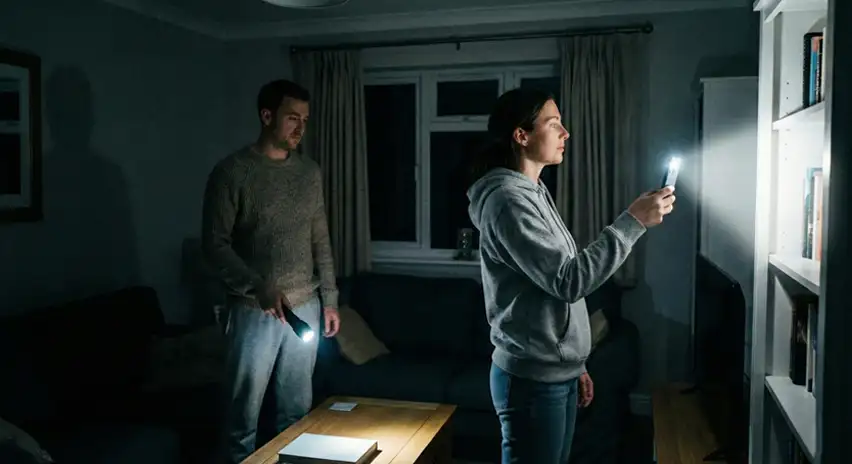
Before you start searching for a torch or fumbling with your fuse box, you need to establish the scale of the problem. Is this a total blackout for the neighbourhood, or has a specific electrical fault occurred inside your home?
The best way to find out if the power is out is to look out your window. If it’s daytime, you could ask your neighbour if their electricity is still working. If it’s nighttime, check if the streetlights are on and whether your neighbours have their lights turned on.
If the entire street is dark, the issue is likely a widespread network fault. In this case, there is nothing you can do to fix it yourself (skip to the section below on Reporting a Power Cut).
However, if your neighbours’ windows are glowing and the streetlights are on, but your home is dark, the issue is internal. This means a safety switch in your home has tripped to protect you from a potential fault.
Step 2: Check Your Consumer Unit
If you’ve determined the problem is only in your property, you need to locate your Consumer Unit (commonly known as the fuse box). This is usually found in a hallway, under the stairs, or in a utility cupboard/garage.
Understanding the Switches
When you open the cover, you will see a series of switches.
- The Main Switch: This is usually the large red or black switch that controls all electricity to the house.
- RCDs (Residual Current Devices): These are life-saving switches designed to prevent electric shocks. They cover banks of circuits.
- MCBs (Miniature Circuit Breakers): These are the smaller switches, each controlling a specific room or appliance type (e.g., “Kitchen Sockets,” “Upstairs Lights”).
How to Reset a Tripped Switch
- Look for the switch that is DOWN. In most modern units, the “ON” position is up. If a switch is pointing down, that is the one that has tripped.
- Try to push it back UP.
If it stays up: Great! The power should be back. It might have been a temporary surge or a blown bulb that caused a momentary trip.
If it snaps back down immediately: Do not force it. This indicates a hard fault. There is likely a faulty appliance plugged in somewhere that is actively causing a short circuit.
Step 3: Troubleshooting
If the switch refuses to stay up, you have a “persistent fault.” You need to find the culprit appliance before you can restore power. This is the most common reason homeowners call us, but you can often diagnose it yourself with this simple method:
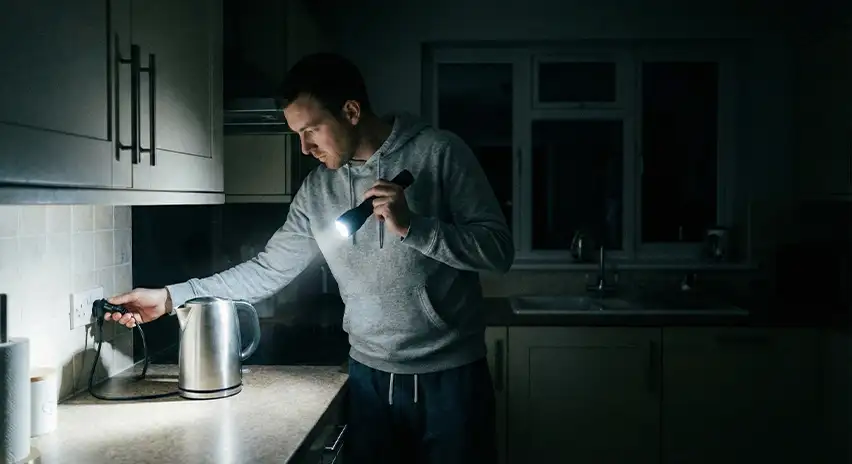
- Unplug everything – Go around the house and unplug every appliance on the affected circuit. If the “Kitchen Sockets” breaker has tripped, unplug the kettle, toaster, microwave, washing machine, and fridge. Simply turning them off at the wall isn’t enough, pull the plug out.
- Reset the Switch – Go back to the consumer unit and flip the tripped switch back to the “ON” position. If it stays on now, you know the wiring in the wall is fine and that one of your appliances is the culprit.
- Plug items back in, one by one – Go back to the kitchen and plug in the kettle. Check the fuse box. Still on? Good. Plug in the toaster. Still on? Good.
- Find the Fault – Eventually, you will plug in one item and the power will go off again. You have found your faulty appliance. Leave that item unplugged and reset your power.
Safety Note: If you unplug everything and the switch still won’t reset, the fault lies within your home’s internal wiring. Do not attempt to fix this yourself. This requires a qualified domestic electrician to investigate safely.
Step 4: Who to Call?
If you looked out the window in Step 1 and saw the whole street was dark, the issue is with the distribution network, not your house.
Dial 105 – This is the free national helpline number for power cuts. No matter who you pay your electric bill to (British Gas, E.ON, Octopus, etc.), calling 105 will automatically route you to your local Distribution Network Operator. They own the cables and are responsible for fixing the cut.
You can also visit powercuts.nationalgrid.co.uk to report a power cut too.
Step 5: Safety Guide During an Outage
Once you’ve reported the cut or identified the issue, you might have to wait a while for power to return. Here is how to keep your home safe during the wait.
1. Fridge and Freezer Discipline
The biggest worry for most people is food spoiling.
- Keep the doors shut – An unopened fridge will keep food cold for about 4 hours.
- Keep your freezer shut – A full freezer will hold its temperature for nearly 48 hours if you keep the door closed. A half-full freezer will last about 24 hours.
- The Golden Rule – Do not open the door just to “check on things.” Every time you open it, you let cold air escape and warm air in.
2. Unplug Sensitive Electronics
When power is restored, it doesn’t always come back smoothly. It can sometimes return with a “spike” or surge in voltage.
Unplug expensive items like TVs, computers, and game consoles. This protects their delicate internal microchips from being fried by a sudden surge when the grid comes back online. Leave one light switch turned on so you know when the power is back.
3. Heating and Warmth
If it’s winter, a house can cool down surprisingly fast.
- Dress in layers – It is much easier to retain body heat with a jumper and a blanket than to try to heat a room without power.
- Close curtains and blinds – Glass is a terrible insulator. Closing the curtains adds a layer of protection against heat loss.
- Do not use outdoor heaters inside – Never be tempted to bring a gas patio heater or a charcoal BBQ inside to warm up. This creates a severe Carbon Monoxide (CO) risk, which can be fatal.
4. Light Sources: Torch vs. Candles
Candles are romantic and traditional, but they are also a major fire hazard, especially if you have pets or children moving around in the dark.
- Stick to battery-powered torches or lanterns.
- Most modern mobile phones have excellent torches, but remember to preserve your battery life in case you need to make an emergency call.
- If you must use candles, place them on a heat-resistant surface and never leave them unattended.
Step 6: When the Power Returns
When the power returns, your lights may flicker, the fridge hums again, and the Wi-Fi router starts blinking. But don’t rush.
- Give it 10 minutes – Sometimes the grid is unstable for the first few minutes. Wait a moment before switching everything back on.
- Plug in essentials first – Start with the fridge and freezer. Then move to the lights.
- Check your timers – Your central heating clock, oven clock, and alarm clocks will likely need resetting.
- Check the Trip Switch – If the power cut was external, your RCD usually won’t trip. However, occasionally a large surge can trip your internal switches even after an external cut. If the street is back on but you aren’t, check your fuse box again.
Need Help? Contact Goodwill Electrical
If you have tried the steps above and still have no power, or if your fuse box is tripping repeatedly and you can’t find the cause, don’t take risks with your safety.
Contact our experienced Birmingham electricians available for emergency call-outs. We can quickly diagnose and fix the issue, ensuring your lights are back on.


