If you take a look around your home, chances are, you will find a lot more gadgets plugged in today than you did five years ago. Between work-from-home office setups, massive entertainment systems, gaming consoles and phone chargers in every room, the modern home is hungry for power.
When you run out of wall sockets, the easiest solution is to grab an extension lead. But what happens when that extension lead runs out of space?
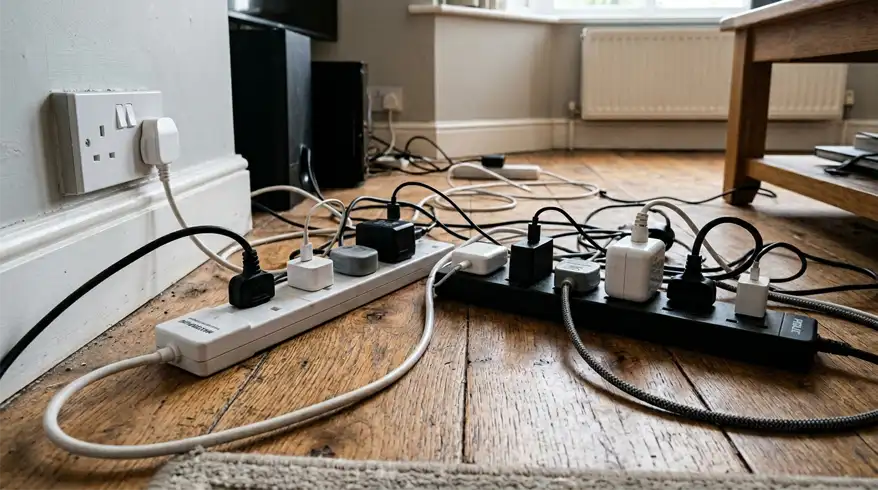
Many homeowners make the simple but dangerous mistake of plugging one extension lead directly into another. In the electrical industry, we call this a “daisy chain” and it is one of the leading causes of hidden electrical fires in UK homes.
Here is exactly why daisy-chaining is so dangerous, how to safely calculate your electrical load and what to look for to keep your home safe.
What is Daisy-Chaining and Why is it a Fire Hazard?
An extension lead is designed to safely carry a maximum amount of electricity, which is usually 13 amps (or around 3000 watts) in a standard UK home. When you plug a second extension lead into the first one, you are not increasing the amount of power the original lead or the wall socket can handle. You are simply adding more appliances that are all trying to draw power through that single, original plug.
As extension leads are not designed to handle this amount of pressure, the fuse might not blow right away. Instead, the wires inside the lead and the plug itself begin to heat up. Over time, this intense, continuous heat melts the plastic casing, exposes live wires and can easily start a fire behind your TV cabinet or under your desk.
The Rule of Thumb for Electrical Load
It is incredibly easy to overload a 13-amp extension lead without realising it, especially in kitchens or home offices. A great rule of thumb to remember is this: Any appliance that generates heat or cooling draws a massive amount of power.
For example, a typical kettle uses around 3000 watts. A portable space heater uses about 2000 watts. If you plug a kettle and a heater into the same extension lead, you are demanding 5000 watts from a lead built to handle 3000. It will overload almost instantly.
Safe usage tips:
- Low-power items are usually fine to share: Things like laptops, phone chargers, broadband routers and LED lamps use very little power. You can safely plug several of these into a single extension lead.
- High-power items get their own wall socket: Kettles, toasters, space heaters, washing machines and hair dryers should always be plugged directly into a wall socket, never into an extension lead.
2-Minute Extension Lead Safety Check
If you are using extension leads in your home, we highly recommend taking two minutes to perform a quick visual inspection. Look for these four critical warning signs:
- Scorch marks or brown stains: Check around the pinholes of the extension block and the wall socket itself. Any discolouration means the plastic is slowly burning.
- Melted plastic: Run your fingers along the lead and the plug. If the plastic feels warped, bubbled or abnormally soft, unplug it immediately.
- Hot to the touch: A plug or extension block should never feel hot. If it feels uncomfortably warm, it is overloaded.
- A burning smell: Electrical components often emit a burning smell when the protective plastic begins to burn. If you smell this in a room, isolate your plugs right away.
The Permanent, Safe Solution
Extension leads are meant to be temporary solutions, not permanent fixtures of your home’s wiring. If you find yourself relying on daisy chains to power your home office or living room, the safest thing you can do is have more wall sockets professionally installed.
At Goodwill Electrical, our expert domestic electricians can quickly and cleanly install additional sockets exactly where you need them, taking the dangerous strain off your extension leads and ensuring your home’s wiring is perfectly safe.
Need more sockets or worried about an overloaded circuit? Get in touch with the friendly team at Goodwill Electrical today for a free, no-obligation quote!